

Blog

What is a Speed Bounce and how can primary and secondary schools use it?
If you’re looking for a simple way to develop speed, rhythm and co-ordination in school athletics, Speed Bounce is an easy activity to introduce. Used within Sportshall Athletics, pupils simply bounce from side to side over a foam wedge, making it a practical activity for primary and secondary PE lessons, activity stations and indoor athletics competition.
It sounds simple, but maintaining a quick and consistent rhythm while keeping both feet together gives pupils plenty to work on. It also provides an easy-to-understand challenge where they can practise the movement, record a performance and see their own progress.
What equipment do you need for the Speed Bounce?
Speed Bounce is a Sportshall field event that tests speed, rhythm, co-ordination and agility. The participant starts with both feet together on one side of the foam wedge and bounces from side to side, completing as many correct bounces as possible within the allocated time.
For the standard Sportshall activity, you need:
- a Speed Bounce Mat
- a stopwatch
- a whistle
This makes it a straightforward activity to include within a school athletics session. It can be used on its own or alongside other Sportshall activities to give pupils experience of different movement and athletics skills.
How to do the Speed Bounce?
Start by giving pupils time to learn the movement before introducing a timed challenge.
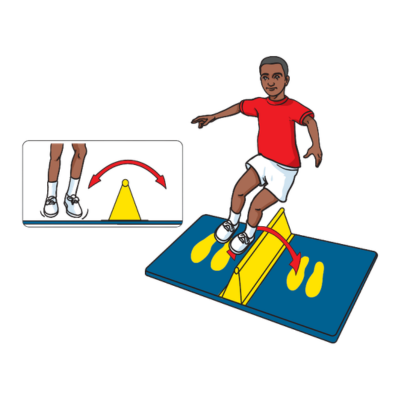
The Sportshall activity works as follows:
- Start on the mat with both feet together on one side of the wedge
- On the whistle, bounce sideways over the wedge
- Land with both feet touching the mat on the opposite side at the same time
- Continue bouncing from side to side for the allocated test period
- Stop on the final whistle
Both feet need to touch the mat on each side at the same time for a bounce to count. If the pupil lands on the wedge, that bounce is void. If they touch the wedge but both feet still cross to the other side, the bounce counts.
A short practice period is useful before recording a score so pupils have an opportunity to become familiar with the test. For formal testing, two judges are recommended, with one timing and the other counting the correct bounces.
You can find the full activity rules and guidance in the Sportshall Athletics Handbook
What are the benefits of a Speed Bounce?
One of the main benefits of Speed Bounce is that the movement is easy for pupils to understand while still providing a challenge as they try to maintain their rhythm.
The activity specifically tests:
- speed
- rhythm
- co-ordination
- agility
It also works well as part of a varied athletics session. Sportshall itself covers indoor running, jumping and throwing activities and is designed to support multi-skills development, participation and athletics teaching across different abilities.
Rather than making every attempt about the highest score, teachers can give pupils opportunities to practise the movement first and then compare their own performances. This keeps improvement and effort visible while still providing the challenge many pupils enjoy.
Using the Speed Bounce in primary schools
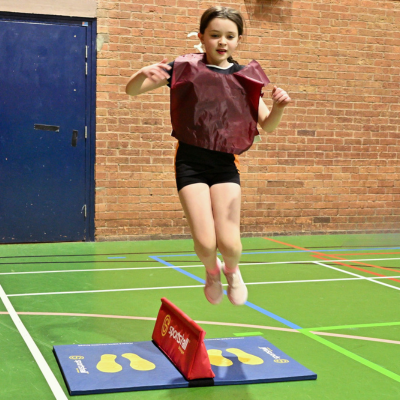
For primary pupils, start with the movement itself.
Give children an opportunity to practise bouncing from one side of the wedge to the other with their feet together before adding the pressure of the stopwatch. Once the movement becomes more familiar, you can introduce the timed test.
In Sportshall competition, the primary Speed Bounce test lasts 20 seconds.
You can also turn Speed Bounce into a team activity.
The Pacesetter book includes an activity called Boing. Teams have their own Speed Bounce Mat positioned two metres in front of a starting line. Each pupil runs to the mat, completes ten Speed Bounces and moves away so the next team member can take their turn.
It is a useful example of how the equipment can move beyond an individual test and become part of a more active group session.
You can find out more about the Boing activity in the Pacesetter book.
Using Speed Bounce in secondary schools
At secondary level the basic movement and rules stay straightforward, but the formal competition test becomes longer.
The Sportshall competition test period for secondary Speed Bounce is 30 seconds.
If you’re preparing pupils specifically for competition, make sure the practice reflects the appropriate format.
Speed Bounce can also form one part of a wider activity circuit. This station approach is a practical way to include several athletics skills within the same session rather than keeping the whole class on one activity.
Schools can use Sportshall activities individually or combine them into structured stations for groups or classes.
Using Speed Bounce for Sportshall competition
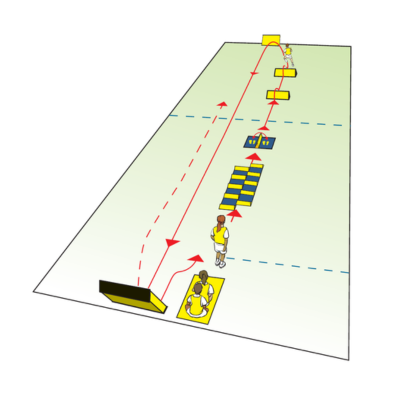
As well as being an individual field event, Speed Bounce features within the Sportshall Obstacle Relay. In this event, participants complete the Hi-Stepper, followed by ten Speed Bounces and then clear two hurdles before continuing around the course.
That gives the equipment more than one possible role. You can introduce the basic technique during PE, develop confidence through repeated practice and then use the movement within a team activity or competition format.
Did you know?

The England Sportshall Speed Bounce record for the Under 14 age group is an incredible 99 bounces.
How many can your pupils do?
Practical tips for teaching the Speed Bounce
A few simple points can make the activity easier to deliver.
- Give pupils a practice first
The Sportshall guidance includes a trial period so participants can become familiar with the activity before completing the test. - Watch the feet, not just the speed
Both feet need to touch the mat at the same time on the opposite side for a bounce to count. - Use two roles when formally testing
Where possible, have one person watch the stopwatch and another count correct bounces. - Check footwear and the mat before starting
Participants should wear suitable shoes that are securely fastened. The Sportshall guidance also states that a judge can keep a foot on the corner of the mat to help prevent it slipping.
Above all, give pupils a chance to get comfortable with the technique. Speed Bounce is simple enough to get started quickly but leaves room for children to develop their rhythm, improve their score and enjoy seeing their own progress.
Ready to introduce Speed Bounce at your school?
Speed Bounce can be a useful starting point if you’re introducing indoor athletics or adding more variety to an existing PE programme. You can teach it as one activity, build it into a station-based lesson or develop it towards Sportshall competition.
If you’re planning a wider programme, explore the Sportshall School Equipment Packs, Sportshall Jumping Equipment and Sportshall Competition Equipment to find equipment for broader indoor athletics delivery.
For further activity ideas and Sportshall guidance, you can also explore the resources available through Sportshall.org.